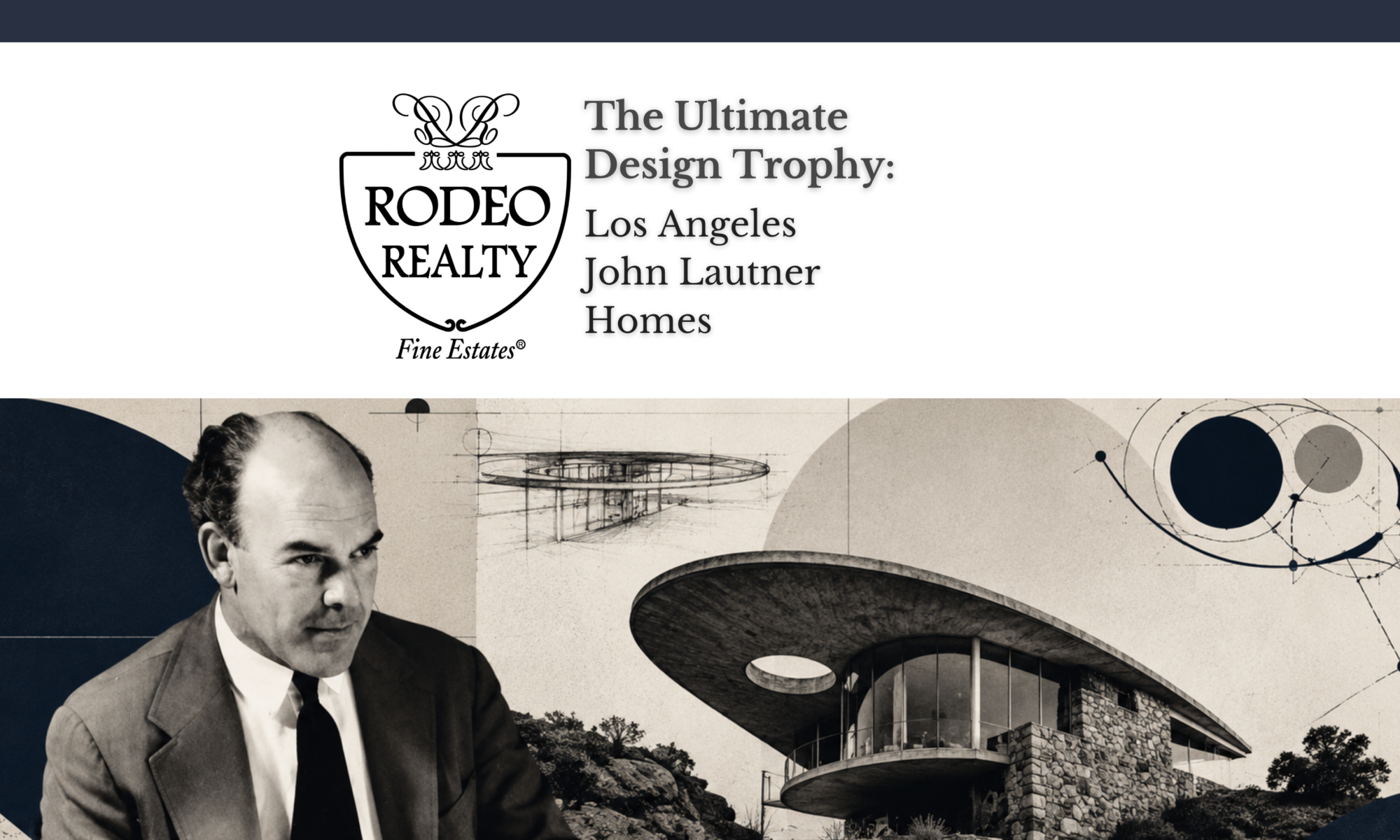
As the sun dips below the horizon of the Santa Monica Mountains, casting a golden hue over the ridges of Southern California, few sights arrest the eye quite like the historic inventory of Los Angeles John Lautner homes. Glass walls appear to dissolve entirely into the surrounding flora. Dramatic, sweeping rooflines of raw concrete hover with impossible lightness above the rugged terrain. Indoor living spaces project boldly out toward panoramic city vistas, erasing the traditional boundary between domestic shelter and the natural world. Decades after their mid-century completion, these structures do not merely look historic; they still feel distinctly futuristic.
That is the singular, enduring magic of John Lautner’s vision.
In a metropolis defined by rapid reinvention and fleeting architectural trends, Lautner’s residential creations have achieved an extraordinary milestone: they have remained utterly relevant through generations of shifting aesthetic tastes. While countless residential fads have risen and fallen, the global demand for Los Angeles John Lautner homes continues to intensify. Today, these homes are sought after by a highly competitive inner circle of fine art collectors, design purists, and ultra-high-net-worth buyers who recognize that a home can double as a timeless monument of cultural heritage.
Breaking the Box: The Evolution of Organic Modernism
To fully appreciate why these properties command such unmatched reverence in the modern luxury landscape, one must look at the radical philosophy of the man who drafted them. John Lautner arrived in Southern California after a formative, multi-year apprenticeship under Frank Lloyd Wright at Taliesin. While Wright’s core doctrine of organic architecture profoundly shaped the young architect’s worldview, Lautner rejected the temptation to simply mimic his mentor’s signature Prairie or Usonian styles. Instead, he forged an aggressive, space-age design language that was entirely his own.
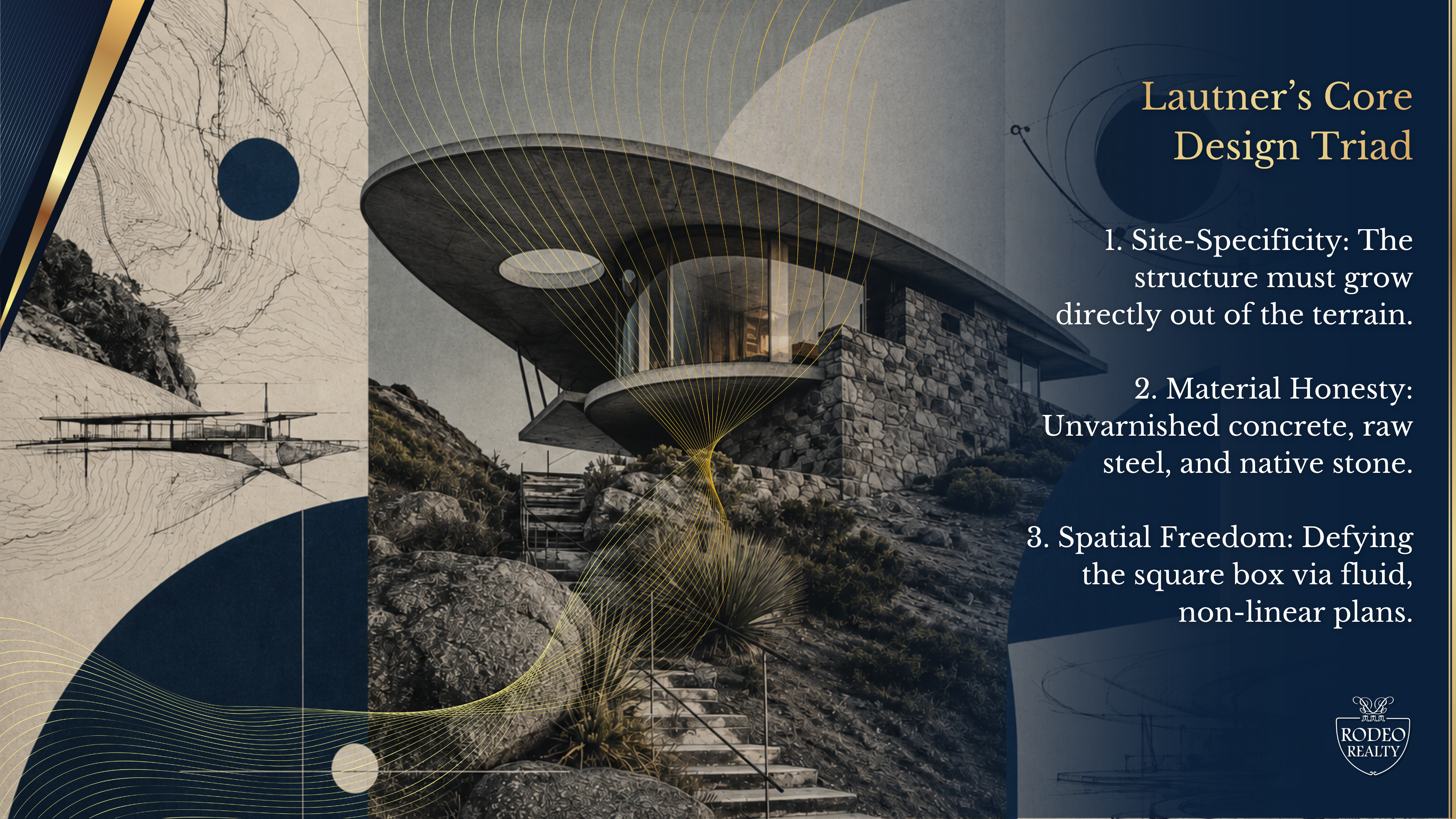
Rather than flattening a hillside to accommodate a standard residential footprint, Lautner insisted that architecture should adapt to, and emerge from, the natural topography. He viewed a house not as a static arrangement of orthogonal walls, but as a fluid, emotional experience dictated by gravity, shadow, and light.
This philosophy found its ultimate canvas in the dramatic canyons, steep ridges, and expansive overlooks of the Westside and the Hollywood Hills. By utilizing advanced engineering techniques like prestressed concrete cantilevers and hyper-geometric rooflines, Lautner transformed seemingly unbuildable lots into gravity-defying residential masterworks that fundamentally re-engineered the California lifestyle.
The Finite Supply of Elite Architectural Masterpieces
In the upper echelons of the luxury housing market, absolute scarcity is the ultimate driver of long-term economic value. This reality underpins the incredible market performance of Los Angeles John Lautner homes. Unlike contemporary luxury developers who frequently replicate profitable, boxy floor plans across multiple speculative estates, Lautner approached every single project as a singular, deeply personal artistic commission.

He famously spent weeks studying the solar paths, wind patterns, and geological strata of a site before drawing a single line. Consequently, no two Lautner homes are alike.
To acquire one is to possess an irreplaceable piece of architectural history. Because his total residential output was strictly limited by the bespoke nature of his practice, the global supply of these homes is permanently fixed. With a finite number of authentic structures in existence, opportunities to acquire a Lautner estate occur only a handful of times in a generation, igniting intense international competition whenever a listing debuts.
Topography and Geometry: Mapping LA’s Mid-Century Masterworks
While Lautner’s radical designs are scattered across Southern California, ranging from the iconic, saucer-like Chemosphere perched on its city-approved concrete pedestal in the Hollywood Hills to the hidden architectural gems tucked into the canyons of Brentwood and Silver Lake, his footprint defines the visual landscape of elite LA.
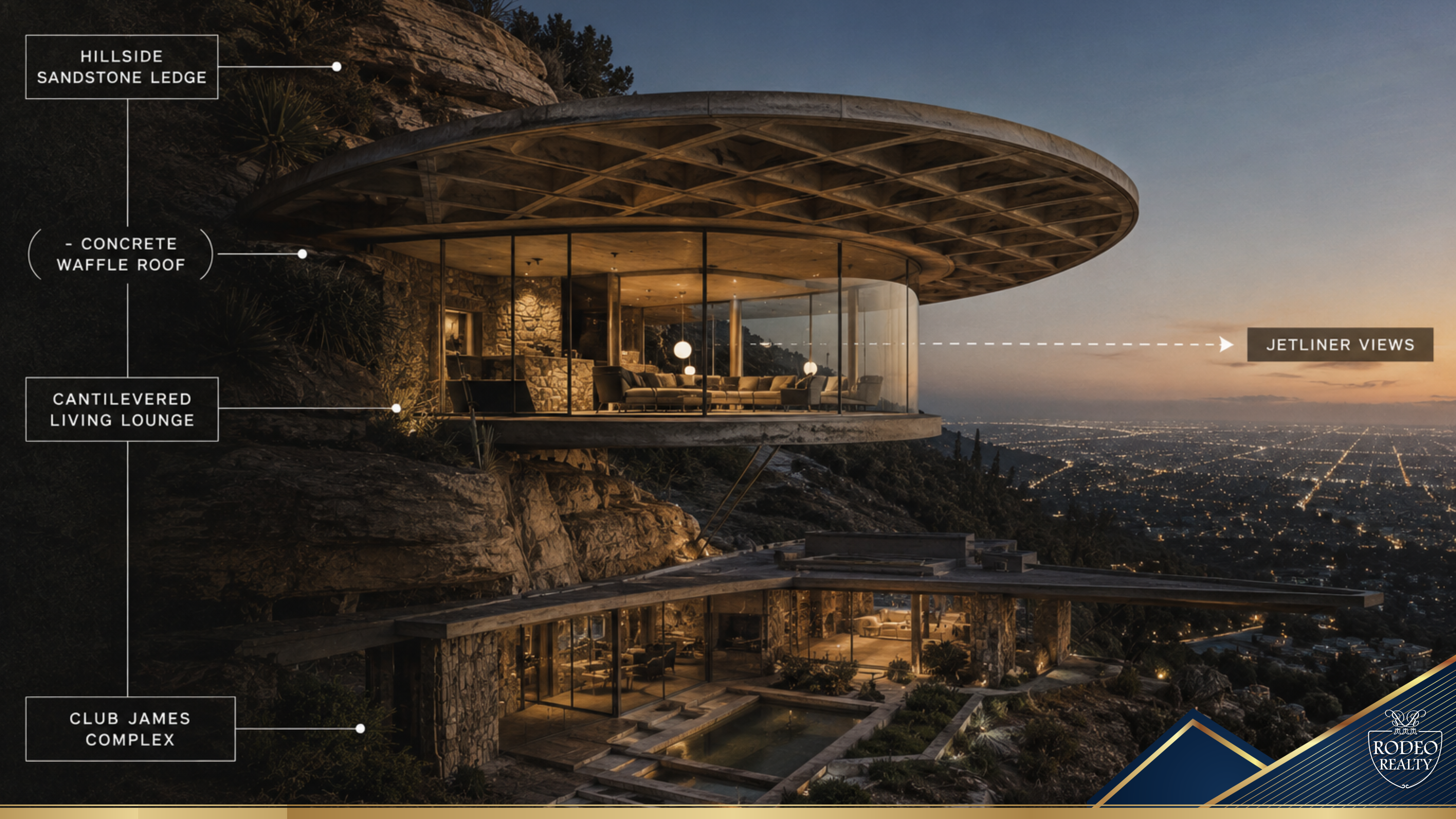
Consider the world-renowned Sheats-Goldstein Residence in the hills bordering Beverly Crest. A concrete masterpiece defined by its coffered, waffle-patterned ceilings and integrated triangular skylights, the home has spent decades evolving. Under the meticulous stewardship of James Goldstein, and more recently through refined interventions by preservation architects Conner + Perry, the property has expanded to include Club James, which is a spectacular entertainment complex buried beneath an infinity-edge tennis court.
Further demonstrating the eternal demand for these properties, the iconic Wolff Residence overlooking the Sunset Strip, famed for its structural homage to Frank Lloyd Wright using stone, glass, and copper, recently entered a new chapter of preservation under Clive Wilkinson Architects for filmmakers and high-profile collectors. Even Lautner’s early works, like the brilliantly restored Jules Salkin House in Echo Park, which was carefully revived by architect Barbara Bestor, showcase how these homes anchor the neighborhoods they inhabit. When evaluating the landscape of Los Angeles John Lautner homes, the premium lies in this unrepeatable geography and structural brilliance. For buyers tracking active Los Angeles John Lautner homes inventory, these estates represent the absolute pinnacle of architectural expressionism.
Physical Assets as Blue-Chip Art
In recent years, the world’s most sophisticated real estate investors have fundamentally shifted how they categorize historically significant homes. As such, many are no longer evaluating an estate purely through traditional metrics. Think cost-per-square-foot or local neighborhood comps. In fact, many are treating these homes as collectible, blue-chip assets. Likewise, finding such investments comparable to an important canvas by Mark Rothko or Jean-Michel Basquiat.
An ordinary luxury estate can be built by anyone with a sufficient budget. A Lautner home, however, requires a pedigree of artistic genius that capital alone cannot recreate.
This conceptual evolution has decoupled iconic mid-century modern architecture from standard residential real estate market cycles. When a prominent Lautner home hits the market, the buyer pool is not restricted to local families looking to relocate within a specific zip code.
Instead, the property draws intense scrutiny from international art patrons, institutional collectors, and design-minded investors hailing from London, Tokyo, New York, and Geneva. This vast, cross-border demand provides these unique structures with a level of long-term financial resilience that conventional luxury properties rarely match.
The Stewardship and Precision of Historic Restoration
Owning an architectural marvel of this caliber is an exercise in cultural stewardship. Because many of Lautner’s most prominent residences were constructed between the 1940s and the 1980s, preserving their structural integrity while adapting them to modern living standards requires specialized architectural expertise, master craftsmanship, and a significant financial commitment.
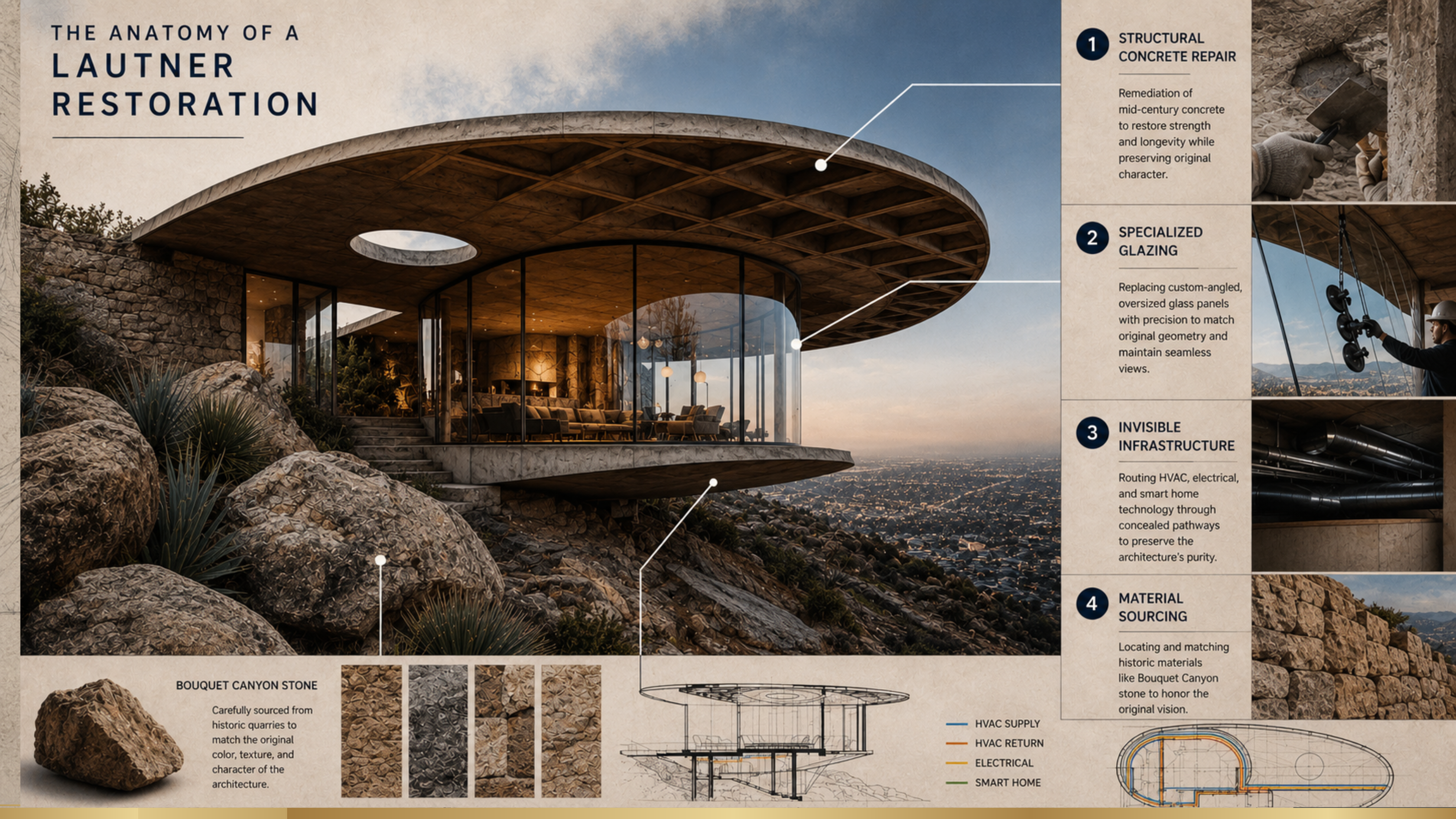
The most celebrated restoration projects are executed with extreme restraint. Top-tier preservation architects focus on updating vital mechanical systems. Additionally, they focus on enhancing energy efficiency and integrating discreet smart-home technology. Of course, this means leaving the original material palette and spatial flow entirely untouched.
When a property boasts a meticulously documented, historically accurate restoration, its value in the marketplace escalates dramatically. Discerning collectors appreciate estates where preservation has been handled with flawless precision. This, of course, ensures the home remains pristine for decades to come.
Capital Appreciation Outside the Traditional Market Cycle
It is a well-known axiom in high-end real estate that price does not automatically equate to permanent value. Architecturally significant Los Angeles John Lautner homes are structurally insulated from this type of functional obsolescence.
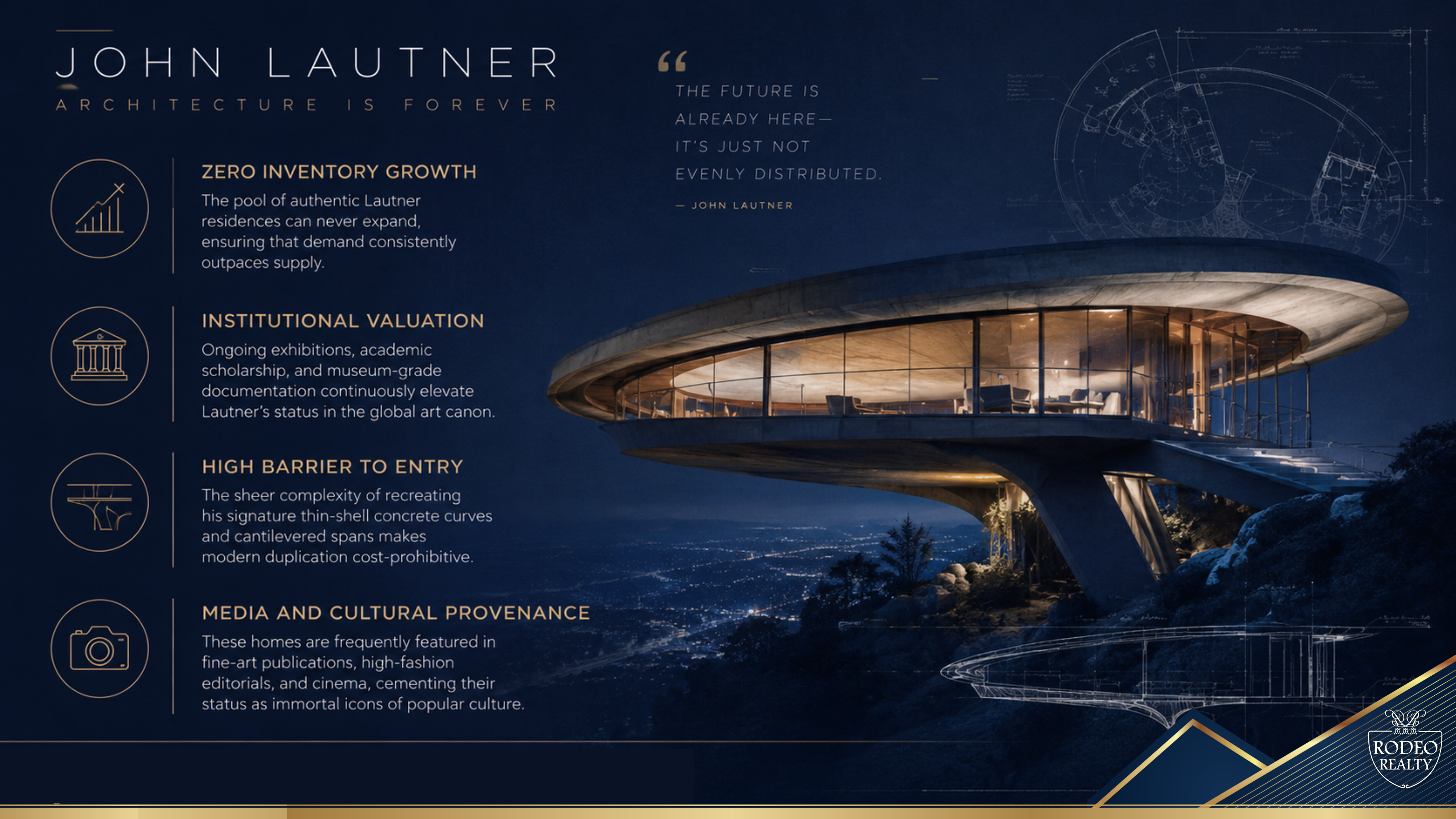
Several clear market dynamics drive their steady, multi-decade capital appreciation:
- Zero Inventory Growth: The pool of authentic Lautner residences can never expand, ensuring that demand consistently outpaces supply.
- Institutional Valuation: Ongoing exhibitions, academic scholarship, and museum-grade documentation continuously elevate Lautner’s status in the global art canon.
- High Barrier to Entry: The sheer complexity of recreating his signature thin-shell concrete curves and cantilevered spans makes modern duplication cost-prohibitive.
- Media and Cultural Provenance: These homes are frequently featured in fine-art publications, high-fashion editorials, and cinema, cementing their status as immortal icons of popular culture.
The Lasting Imprint on Contemporary Luxury Design
The sweeping influence of Lautner’s design principles can be seen across the entire landscape of modern luxury architecture. Even when contemporary buyers tour a newly built estate on the Westside without knowing the architect’s name, they are frequently admiring design elements that Lautner pioneered over half a century ago.
The floor-to-ceiling glass walls slide open at the touch of a button. Seamless transition from indoor lounge spaces to outdoor infinity pools. The use of board-formed concrete as an elegant interior finish. Dramatic cantilevered room volumes that hover over steep hillsides. All of these features trace their lineage directly back to his mid-century masterpieces.
An original Lautner home possesses an organic authenticity and emotional resonance that cannot be manufactured by modern speculation developers.
The Immersive Experience of Daily Life
The financial metrics and architectural lineage of these properties dominate high-end real estate discussions. But, contrary to popular belief, the true value of a Lautner home is discovered in the quiet moments of daily occupancy. Living within one of these spaces is an active, evolving dialogue with nature.
Owners frequently recount how morning light filters through geometric openings in unexpected ways. Additionally, reflecting how changing seasons alter the mood of the main living spaces. As such, the landscaping provides an elegant shift outside the glass walls. The architecture is explicitly engineered to respond to the environment. Of course, such a design makes the home feel like a living, breathing organism rather than a static box. This profound emotional connection creates an intensely loyal network of owners. Likewise, many of whom rarely part with their properties willingly. This, of course, further limits the availability while increasing the value and demand of Los Angeles John Lautner homes.
Frequently Asked Questions

What makes Los Angeles John Lautner homes stand out from other mid-century properties?
Many mid-century architects utilized standard post-and-beam wood construction to create simple geometric structures. Lautner, however, pushed the boundaries of structural engineering. He combined raw, industrial materials like reinforced concrete, steel, and stone. This was done to form fluid, sculptural spaces that integrated seamlessly with the complex, steep topography of the local hillsides.
How does the historical designation of a Lautner home affect its ownership?
Many of Lautner’s residential projects are designated as City of Los Angeles Historic-Cultural Monuments. This prestigious status can grant owners substantial property tax benefits under California’s Mills Act. Of course, this comes in exchange for a strict commitment to preserving the historic authenticity of the structure. It also ensures that the home’s architectural legacy remains protected from unsympathetic modifications.
Are Lautner properties suitable for modern, tech-forward lifestyles?
Absolutely. When guided by expert preservation architects, a Lautner home can easily accommodate modern infrastructure. Think upgraded climate control and high-fidelity security. In addition, you can find seamless ways to blend premium smart-home automation into the home’s native geometric channels. This, of course, can be done without disrupting the historic aesthetic or damaging the original material fabrication.