
Economic Update | Week Ending June 6th, 2026

Weekly wrap-up – Despite another better-than-expected jobs report for the third consecutive month, stocks pulled back this week, with the S&P 500 posting its first meaningful weekly decline after several consecutive weeks of gains. Much of the weakness was tied to renewed concerns over valuations, profit taking after the market’s strong rebound, and lingering uncertainty surrounding interest rates, tariffs, and global economic growth. Investors also reacted to mixed economic data and rising Treasury yields earlier in the week, which put pressure on technology and other growth-oriented sectors that had led the recent rally.

Even though stock markets had a down week, the broader market has remained resilient over the past several months as investors continue to anticipate eventual Federal Reserve rate cuts and a soft-landing economy. Employment data has generally remained stable, consumer spending has held up reasonably well, and corporate earnings have largely exceeded expectations. While volatility may continue in the near term, many analysts still believe the long-term trend for equities remains constructive provided inflation continues to moderate and the economy avoids a significant slowdown.

Mortgage rates – Every Thursday, Freddie Mac publishes interest rates based on a survey of mortgage lenders throughout the week.

The Freddie Mac Primary Mortgage Survey reported that mortgage rates for the most popular loan products as of June 4, 2026, were as follows: The 30-year fixed mortgage rate was 6.48%, down from 6.53% last week. The 15-year fixed was 5.79%, down from 5.87% last week.

The graph below shows the trajectory of mortgage rates over the past year.

U.S. employers added 172,000 new jobs in May – The Bureau of Labor and Statistics reported that 172,000 new jobs were created in May, far surpassing analyst’s expectation of 80,000 new jobs. The unemployment rate held steady at 4.3%, for the third consecutive month. Average hourly wages increased 3.4% from one year ago, the lowest year-over-year increase since May 2021.

Average hourly wages increased 3.4% from one year ago, the lowest year-over-year increase since May 2021.

Stock markets – The Dow Jones Industrial Average closed the week at 50,866.78, down 0.4% from 51,032.36 last week. It is up 5.8% year-to-date from 48,063.29 on December 31, 2025. The S&P 500 closed the week at 7,383.74%, down 2.7% from 7,589.06 last week. The S&P is up 7.9% year-to-date from 6,845.50 on December 31, 2025. The Nasdaq closed the week at 25,709.43, down 4.7% from 26,972.62 last week. It is up 10.6% year-to-date from 23,241.99 on December 31, 2025.

U.S. Treasury Bonds – The 10-year treasury bond closed the week yielding 4.55%, up from 4.45% last week. The 30-year treasury bond yield ended the week at 5.01%, up slightly from 4.99% last week. We watch bond yields because mortgage rates follow bond yields.

Next week the government will release the Consumer Price Index for May. That will show how much rising gas and energy costs are causing inflation to rise. That will have an impact on interest rates.

The Zip Code Premium: Why Families Will Pay Anything to Be in BHUSD Borders

bhusd

For parents, the  Beverly Hills Unified School District (BHUSD) is tied to one of the most sought-after zip codes in the country. Offering nationally ranked academics, specialized career pathways, and a diverse array of extracurricular activities, it is no surprise Southern California parents want their kids to have the premier BHUSD educactional experience.

However, securing a home within this prestigious school district requires navigating a complex and highly competitive real estate landscape. On the Westside of Los Angeles, a single street can mean the difference between a multi-million dollar property zoned for a top-tier municipal school system or one that falls into a completely different district. Understanding the geographical boundaries and financial implications of the “zip code premium” is essential for families looking to make a calculated investment in both their children’s future and their property’s equity.

Navigating the Map: BHUSD vs LAUSD Real Estate Boundaries

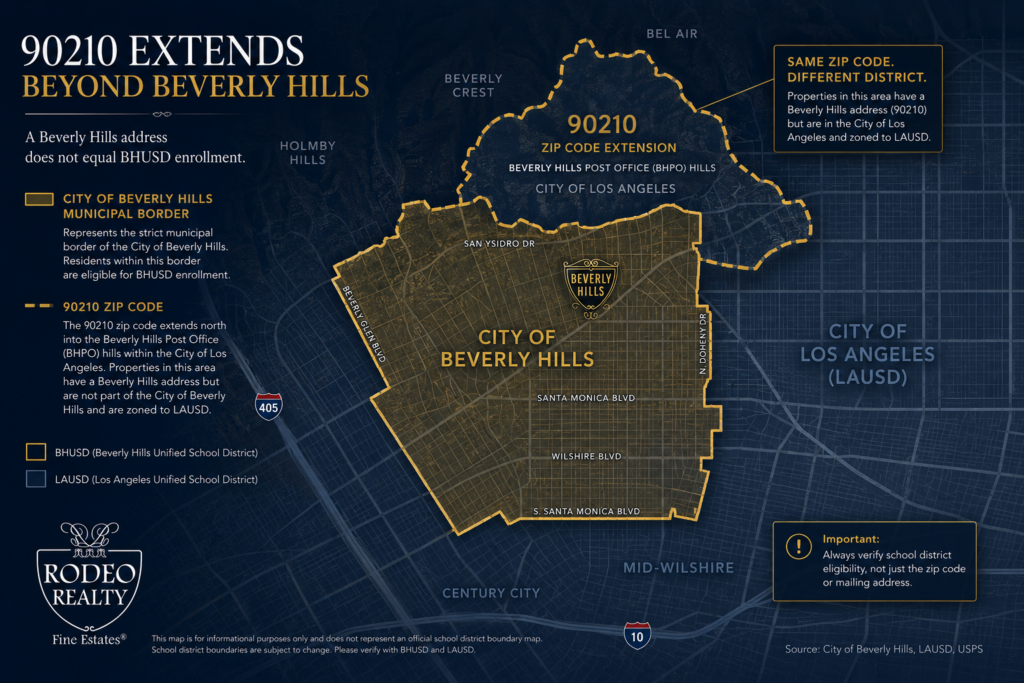
When searching for homes for sale in Beverly Hills Unified School District, many buyers fall into the “BHPO Trap”.

Beverly Hills Post Office (BHPO) refers to the hillsides located directly north of the city limits. Properties in this enclave enjoy the prestigious “Beverly Hills, CA 90210” mailing address, but they sit outside the actual municipal boundaries of the City of Beverly Hills. Because school district boundaries follow municipal borders rather than postal zip codes, homes in BHPO are zoned for the Los Angeles Unified School District (LAUSD) rather than BHUSD.

To illustrate just how stark this boundary line is, consider the map below:

BHUSD school district houses

This boundary line creates a massive real estate discrepancy. Two identical luxury estates can sit just doors apart on the same street, yet the home located inside the official city line will command a significantly higher premium solely due to its guaranteed access to Beverly Hills schools.

The Financial ROI of Dedicated Municipal Infrastructure

The value premium associated with BHUSD is driven by an independent, hyper-localized funding model. Unlike larger, stretched school districts that rely heavily on fluctuating state education budgets, BHUSD benefits directly from Beverly Hills’ independent municipal tax base and the robust support of the Beverly Hills Education Foundation (BHEF).

This consistent financial backing allows the district to maintain state-of-the-art facilities, keep class sizes small, and attract top-tier educators. For luxury real estate buyers, paying the property premium to live within BHUSD borders often represents a highly analytical financial play rather than just an emotional lifestyle choice.

Southern California Residents will use money that would have otherwise gone to private school tuitions toward a home in the BHUSD. And this makes sense considering private school tuition can cost upwards of 30K – 50K per year, per child. So this is something for parents to take into calculation. 

Giving Kids an Educational Advantage

Some educational experts extoll the value of schooling as the ultimate decider of a child’s success – or, at least, as a very heavy indicator. Others point more to the family environment. However, we’d all agree that schooling has at least SOME impact on the lives of our kids. And so parents do what they can. Some pay steep private school tuitions, while others compete for a seat at the best public schools. The question, though, is whether or not it’s really worth it? What’s the real difference between an “elite” vs “average” school district? 

From Kindergarten to College Prep: Inside the BHUSD Ecosystem

The educational framework of Beverly Hills is meticulously structured to guide students seamlessly from early childhood through high school graduation. The district’s unique neighborhood-centric model includes highly acclaimed K-8 schools – such as Beverly Vista, Horace Mann, and Hawthorne – before students graduate into the historic Beverly Hills High School.

BHUSD is widely recognized for offering programs that rival elite private institutions, including:

  • Advanced Robotics & STEM Labs: Dedicated spaces equipped for early engineering and competitive robotics.
  • Proprietary TV Studios (KBEV): The longest-running student-run television station in the country, offering unmatched career technical education in media and broadcasting.
  • Elite Athletic Infrastructure: State-of-the-art sports facilities, swimming centers, and training grounds funded through dedicated municipal bonds.
  • Culinary Arts & Specialized Pathways: Professional-grade vocational pathways designed for early career exposure.

Living within the city limits ensures that children can walk or take short commutes to these neighborhood hubs, fostering a tightly-knit, secure community environment that defines the Beverly Hills lifestyle.

Frequently Asked Questions

Q: What is the difference between Beverly Hills city limits and BHPO (Beverly Hills Post Office) school districts?

A: Homes located within the official Beverly Hills city limits are legally zoned for the Beverly Hills Unified School District (BHUSD). Homes in the BHPO area carry a Beverly Hills mailing address but fall geographically under the Los Angeles Unified School District (LAUSD) jurisdiction.

Q: Can residents of BHPO send their children to BHUSD schools?

A: Generally, no. BHUSD admission requires verified proof of primary residency within the official municipal boundaries of the City of Beverly Hills. While inter-district permit applications exist, they are subjected to highly specific municipal criteria and are rarely granted for general enrollment.

Q: How does being inside the BHUSD boundary affect property resale value?

A: Properties located within the official school district lines consistently command a premium of 15% to 25% compared to similar properties located just across the border in neighboring districts. Furthermore, these homes historically show stronger equity preservation and price stability during real estate market shifts.