
Economic update for the week ending March 7, 2026
It was a tough week for stocks, bonds, and mortgage rates. War in the Middle East has led to a spike in energy prices. Iran has shut down the Strait of Hormuz. About 20% of the world’s oil supply flows through the Strait. A barrel of oil has risen from about $66 per barrel last week to near $90 per barrel on Friday. This quick rise has sparked inflation fears which caused stocks to sell off and bond yields and mortgage rates to rise.
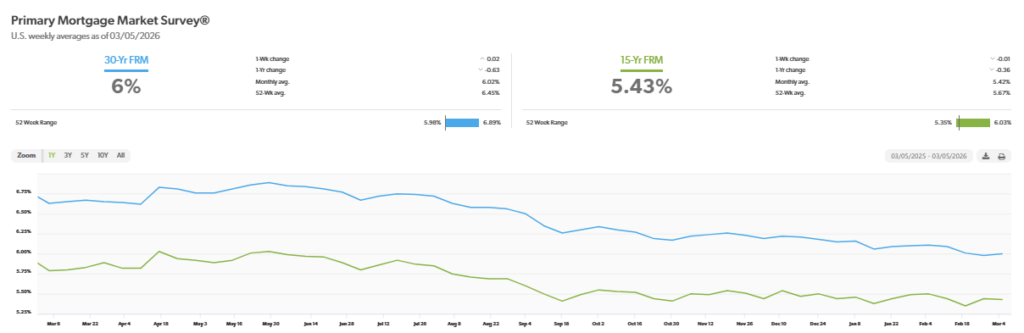
Mortgage rates – What a difference a week makes. We have gone from the lowest mortgage rates since 2022, under 6% for a 30-year fixed mortgage back up to 6.25% in one week. Every Thursday, Freddie Mac publishes interest rates based on a survey of mortgage lenders throughout the week. The Freddie Mac Primary Mortgage Survey reported that mortgage rates for the most popular loan products as of March 5, 2026, were as follows:
The 30-year fixed mortgage rate was 6%, up slightly from 5.98% last week. The 15-year fixed was 5.43%, almost unchanged from 5.44% last week. Unfortunately, the 30-year ended the week at about 6.25% as oil prices spiked raising inflation fears.
The graph below shows the trajectory of mortgage rates over the past year.
U.S. labor market contracted in February – The Bureau of Labor and Statistics released the February jobs report on Friday. It showed that 92,000 jobs were lost in February. The unemployment rate ticked up to 4.4%, from 4.3% in January. Average hourly wages increased 0.4% month-over-month from January and 3.8% from one year ago. Usually, a report like this would cause interest rates and bond yields to fall because less people working leads to less consumer spending. Almost 70% of the economy is fueled by consumer spending, so less spending lowers inflation pressure. Unfortunately, spiking energy prices offset this.
Stock markets – The Dow Jones Industrial Average closed the week at 47,501.55, down 3% from 48.977.92 last week. It is down 1.2% year-to-date from 48,063.29 on December 31, 2025. The S&P 500 closed the week at 6,740.02, down 0.4% from 6,879.98 last week. The S&P is up 0.5% year-to-date from 6,845.50 on December 31, 2025. The Nasdaq closed the week at 22,387.68, down 1.8% from 22,668.21 last week. It is down 3.7% year-to-date from 23,241.99 on December 31, 2025.
U.S. Treasury Bonds – The 10-year treasury bond closed the week yielding 4.15%, up from 3.98% last week. The 30-year treasury bond yield ended the week at 4.77%, up from 4.64% last week. We watch bond yields because mortgage rates follow bond yields.