| Investors pushed stocks up and bond yields down this week. Markets rallied as soon as a ceasefire between Israel and Iran was announced. The Nasdaq and the S&P hit record highs on Friday after being down 12-20% in April. Oil prices had been rising in recent weeks due to the war in the Middle East and Iran’s threat to close the Strait of Hormuz, one of the world’s most crucial chokepoints for oil shipping, where 20% of global petroleum is transported through prior to the ceasefire. This week oil prices dropped 12% from where they were last Friday. There was also more progress on tariff negotiations with China and other countries this week. With oil prices dropping, tariff-related inflation easing, and the economy no longer overheated, several Fed members began speaking optimistically about another interest rate reduction. The next big report will be the jobs report next Friday. If hiring slows, that will put pressure on the Fed to lower rates.
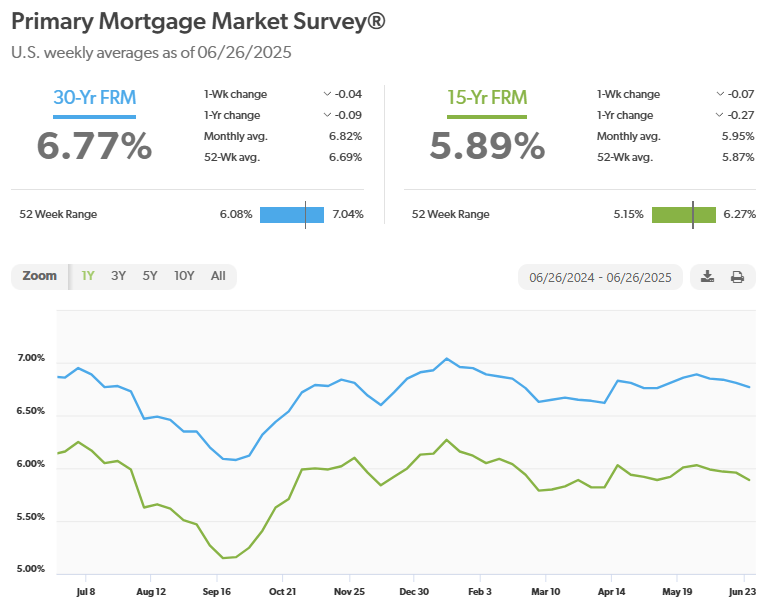
Stock Markets – The Dow Jones Industrial Average closed the week at 43,819.27, up 3.8% from 42,206.82 last week. Year-to-date, it is down 1.6% from 44,544.66 on December 31, 2024. The S&P 500 closed the week at 6,173.07, up 3.5% from 5,967.84 last week. Year-to-date the S&P is up 2.2% from 6,040.53 on December 31, 2024. The Nasdaq closed the week at 20,273.46, up 4.2% from 19,447.41 last week. Year-to-date it is up 3.3% from 19,627.44 on December 31, 2024. U.S. Treasury bond yields – The 10-year treasury bond closed the week yielding 4.29%, down from 4.38% last week. The 30-year treasury bond yield ended the week at 4.85%, down from 4.89% last week. We watch bond yields because mortgage rates follow bond yields. Mortgage rates – Every Thursday Freddie Mac publishes interest rates based on a survey of mortgage lenders throughout the week. The Freddie Mac Primary Mortgage Survey reported that mortgage rates for the most popular loan products as of June 26, 2025, were as follows: The 30-year fixed mortgage rate was 6.77%, down from 6.81% last week. The 15-year fixed was 5.89%, down from 5.96% last week. The graph below shows the trajectory of mortgage rates over the past year.
Freddie Mac was chartered by Congress in 1970 to keep money flowing to mortgage lenders in support of homeownership and rental housing. Their mandate is to provide liquidity, stability, and affordability to the U.S. U.S. existing-home sales May 2025 – The National Association of Realtors reported that existing-home sales totaled 4.03 million units on a seasonal annualized rate in May, down 7% from an annualized rate of 4.06 million units last May. The median price paid for a home sold in the U.S. in May was $422,800, up 1.3% from $417,200 one year ago. There was a 4.6-month supply of homes for sale in May, up from a 3.8-month supply in May 2024. First-time buyers accounted for 30% of all sales. Investors and second-home purchases accounted for 17% of all sales. All cash purchases accounted for 27% of all sales. Foreclosures and short sales accounted for 2% of all sales. Have a Great Weekend! |
News & Media