| Stock markets rebounded with their best week since April 2025 on hopes of a December rate cut – It was a wild month on Wall Street. Stocks fell through the first half of the month as the federal government shutdown dragged on, delaying the September and October jobs reports as well as several key inflation releases. The only major data point that arrived was the Consumer Price Index (CPI), which was required to calculate the annual Social Security cost-of-living adjustment. The shutdown finally ended on November 20, the longest government shutdown in U.S. history, but that news didn’t help the markets. Stocks continued to tumble for nearly two more weeks as investors were left without critical economic data. On November 20, the September jobs report was released showing that the pre-shutdown labor market had picked up. It wasn’t until the final days of the month that sentiment shifted. Several Federal Reserve officials softened their tone, pointing to weakening labor-market indicators and inflation that appears to be leveling off. This was a reversal from their September comments that seemed to indicate that there would be no rate drop in December. Those comments ignited a sharp rebound as investors and economists interpreted the comments indicated another ¼% rate drop would come in December. That helped stock markets end the month with their strongest weekly gain since April 2025, snapping a deep two-week slide and restoring some stability heading into December.
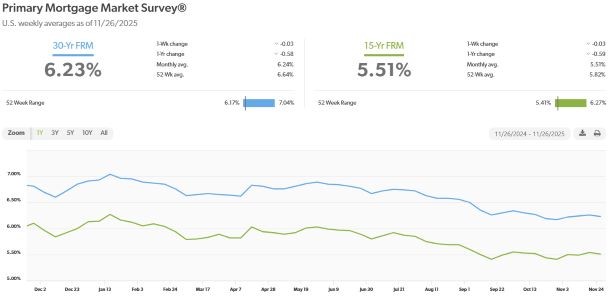
Stock Markets – The Dow Jones Industrial Average closed the week at 47,716.42, up 3.2% from 46.245.41 last week. Year-to-date, it is up 7.1% from 44,544.66 on December 31, 2024. The S&P 500 closed the week at 6,849.09, up 3.7% from 6,602.99 last week. Year-to-date, the S&P is up 13.4% from 6,040.53 on December 31, 2024. The Nasdaq closed the week at 23,365.69, up 4.9% from 22,273.08 last week. Year-to-date, it is up 19% from 19,627.44 on December 31, 2024. U.S. Treasury bond yields – The 10-year treasury bond closed the week yielding 4.02%, down from 4.06% last week. The 30-year treasury bond yield ended the week at 4.67% down from 4.71% last week. We watch bond yields because mortgage rates follow bond yields. Mortgage rates – Every Thursday, Freddie Mac publishes interest rates based on a survey of mortgage lenders throughout the week. The Freddie Mac Primary Mortgage Survey reported that mortgage rates for the most popular loan products as of November 26, 2025, were as follows: The 30-year fixed mortgage rate was 6.23%, nearly unchanged from 6.26% last week. The 15-year fixed was 5.51%, up from 5.54% last week. Rates dropped at the end of the week and Friday’s 30-year rate was close to 6%. The graph below shows the trajectory of mortgage rates over the past year. U.S. existing-home sales – October 2025 – The National Association of Realtors reported that existing-home sales totaled 4.10 million units on a seasonally adjusted annualized rate in October, up 1.2% from the number of homes sold in September and up 1.7% from the number of homes sold last October. The median price paid for a home sold in the U.S. in October was $415,200, up 2.1% from $406,800 one year ago. There was a 4.4-month supply of homes for sale in October, up from a 4.1-month supply last October. First-time buyers accounted for 32% of all sales, up from 30% last month. Investors and second-home purchases accounted for 16% of all sales, down from 15% in August. All cash purchases accounted for 39% of all sales, up from 30% last month. Foreclosures and short sales accounted for 2% of all sales Have a Great Weekend! |
News & Media