Economic Update | Week Ending May 2, 2026

Banner
It was another wild month on Wall Street! It started with a jobs report showing that 178,000 new jobs were added in March. That was triple the 60,000 that expert analysts had forecasted, and a turnaround from February, when there was a net job loss. This showed that the job market was not as dire as previously felt. Then a ceasefire was announced with Iran, which also brought about a rebound from March’s steep losses after the war began. Third-quarter corporate earnings generally beat expectations, and tech and AI profits were stronger than expected as well. Inflation reports were mixed. The CPI report showed that inflation had jumped, but Core CPI, which excludes food and energy, was still under control. Unfortunately, on April 30, the PCE Personal Consumption Expenditures report was released, which showed that inflation was increasing more rapidly due to surging energy costs, which were spilling over into other goods and services. By the month’s end, the Dow surged 7.3% for the month, and the S&P and Nasdaq jumped 10.4% and 15.3%, respectively. That made up all their steep losses when the war started in March and more.

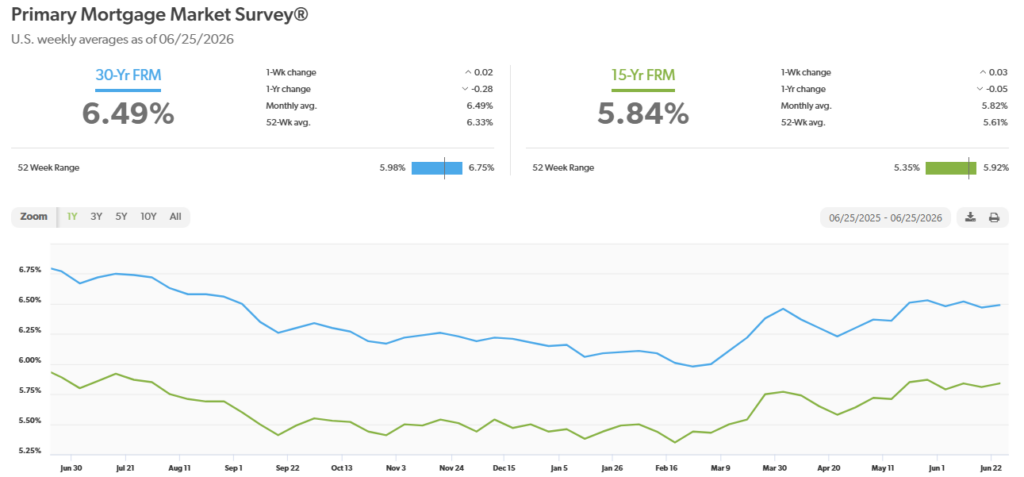
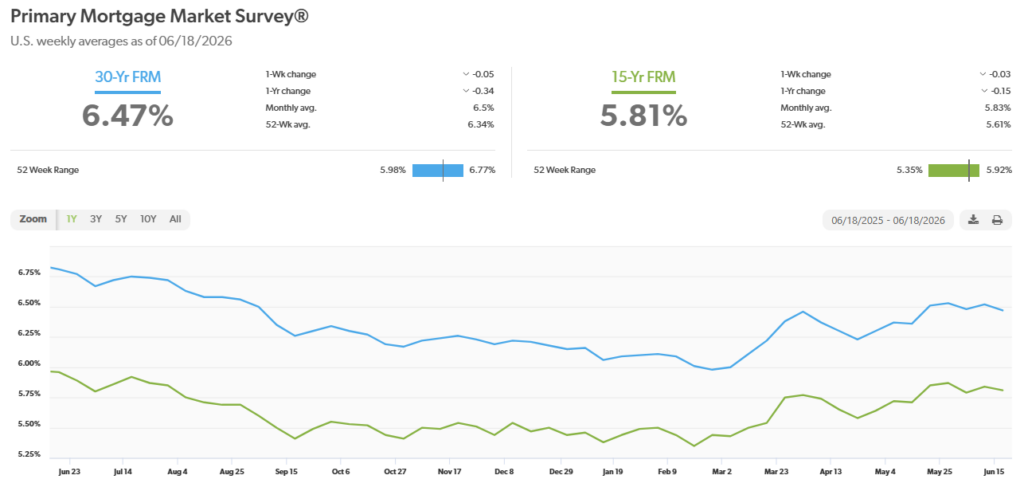
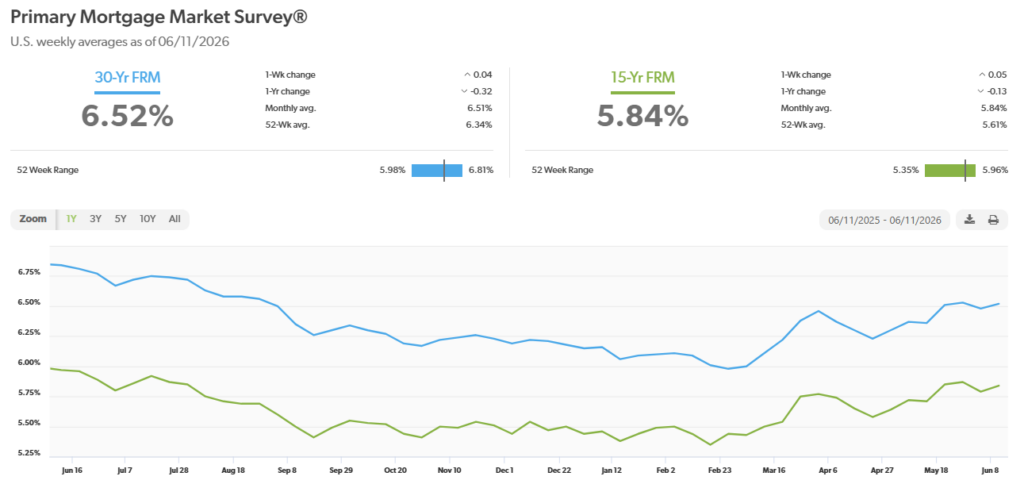
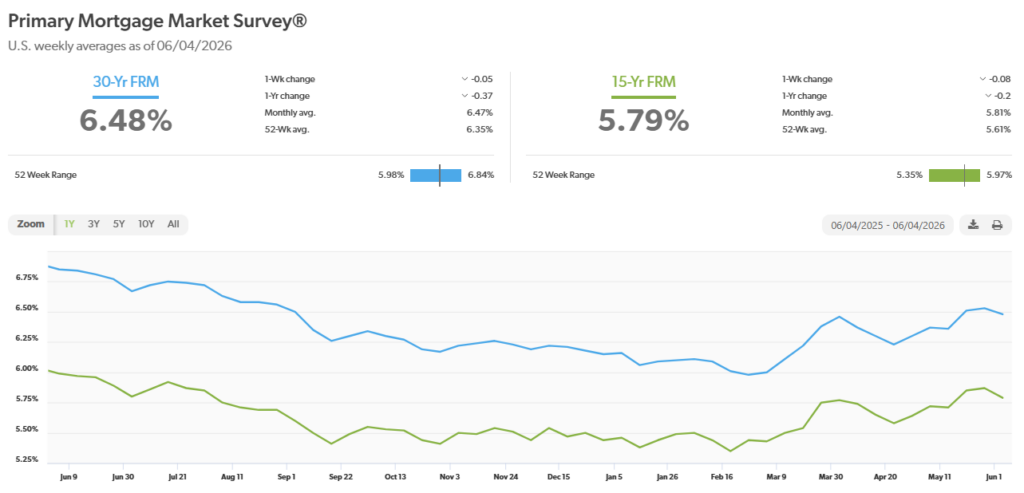
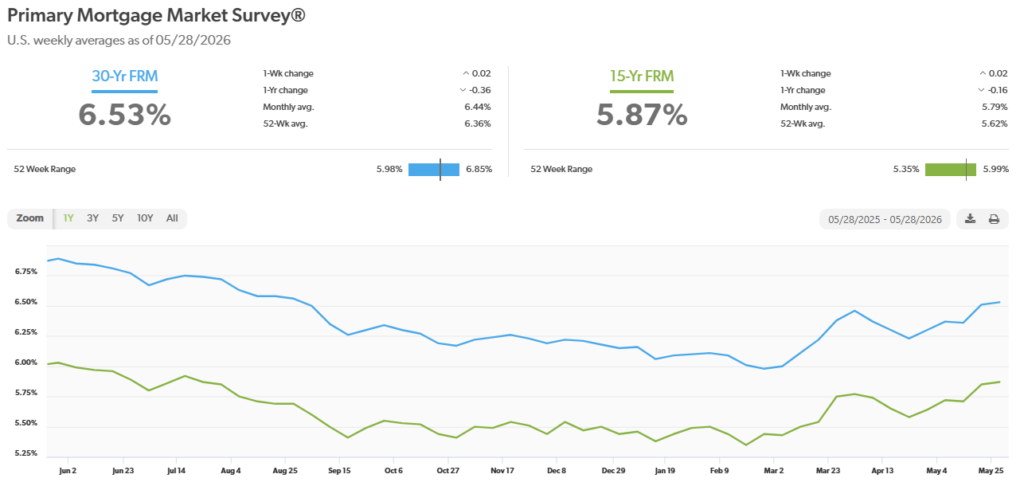
Mortgage rates – Every Thursday, Freddie Mac publishes interest rates based on a survey of mortgage lenders throughout the week. The Freddie Mac Primary Mortgage Survey reported that mortgage rates for the most popular loan products as of March 26, 2026, were as follows: The 30-year fixed mortgage rate was 6.3%, up from 6.23% last week. The 15-year fixed was 5.64%, up from 5.58% last week.

The graph below shows the trajectory of mortgage rates over the past year.

Mortgage Rates GraphStock markets – The Dow Jones Industrial Average closed the week at 49,499.27, down 0.5% from 49,223.80 last week. It is up 2.4% year-to-date from 48,063.29 on December 31, 2025. The S&P 500 closed the week at 7,230.12, up 0.5% from 7,164.83 last week. The S&P is up 4.7% year-to-date from 6,845.50 on December 31, 2025. The Nasdaq closed the week at 25,114.44, up 1.5% from 24,833.05 last week. It is up 6.8% year-to-date from 23,241.99 on December 31, 2025.

U.S. Treasury Bonds – The 10-year treasury bond closed the week yielding 4.39%, up from 4.31% last week. The 30-year treasury bond yield ended the week at 4.97%, up from 4.91% last week. We watch bond yields because mortgage rates follow bond yields.

Economic update for the month ending April 30, 2026

Mortgage rates – Every Thursday, Freddie Mac publishes interest rates based on a survey of mortgage lenders throughout the week. The Freddie Mac Primary Mortgage Survey reported that mortgage rates for the most popular loan products as of March 26, 2026, were as follows: The 30-year fixed mortgage rate was 6.30%, down slightly from 6.38% last month. The 15-year fixed was 5.64%, down from 5.75% last month.

Stock markets – The Dow Jones Industrial Average closed the month at 49,652.14, up 7.3% from 46,286.01 on March 31, 2026. The Dow is up 3.3% year-to-date from 48,063.29 on December 31, 2025. The S&P 500 closed the week at 7,209.01, up 10.4% from 6,527.47 on March 31st. The S&P is up 5.3% year-to-date from 6,845.50 on December 31, 2025. The Nasdaq closed the week at 24,892.31, up 15.3% from 21,592.47 at the end of March. The Nasdaq is up 7.1% year-to-date from 23,241.99 on December 31, 2025.

U.S. Treasury Bond Yields — The 10-year U.S. treasury bond yield closed the month at 4.32%, up from 4.22% On January 31, 2026. The 30-year US treasury bond yield ended the month at 4.91%, up from 4.85% on January 31, 2026. We watch bond yields because mortgage rates often follow treasury bond yields.

Home sales figures are released on the third week of the month for the previous month from the National Association of Realtors and the California Association of Realtors. Here is a summary of the March existing home sales reports.

U.S. existing-home sales – March 2026 – The National Association of Realtors reported that existing-home sales totaled 3.98 million units on a seasonally adjusted annualized rate in March, down 3.6% from the number of homes sold in February. Year-over-year home sales were down 1% from the number of homes sold last March. The median price paid for a home in the U.S. in March was $408,800, up 1.4% year-over-year from $403,100 last March.

California existing-home sales – The median price soared 7.1% in March as inventory tightened – The California Association of Realtors reported that existing-home sales totaled 265,320 on an adjusted annualized basis in March, down 3.5% from 274,820 annualized sales in February and down 2.5% from 272,020 last March. The statewide median price paid for a home in was in $889,190, in March up 7.1% from $830,370 in February. Year-over-year March’s median price was up 0.4% from $885,900 one year ago. There were fewer listings in February. Housing inventory declined 17.5% month-over-month in March. The unsold inventory index dropped to a 3.3-month supply of homes for sale in March, down from 4-month in February.

Below is the housing data for Southern California by County.

County Data


Economic Update | Month Ending April 30, 2026

Mortgage rates – Every Thursday, Freddie Mac publishes interest rates based on a survey of mortgage lenders throughout the week. The Freddie Mac Primary Mortgage Survey reported that mortgage rates for the most popular loan products as of March 26, 2026, were as follows: The 30-year fixed mortgage rate was 6.30%, down slightly from 6.38% last month. The 15-year fixed was 5.64%, down from 5.75% last month.

The graph below shows the trajectory of mortgage rates over the past year.

Mortgage Rates GraphIt was another wild month on Wall Street! It started with a jobs report showing that 178,000 new jobs were added in March. That was triple the 60,000 that expert analysts had forecast, and a turnaround from February, when there was a net job loss. This showed that the job market was not as dire as previously felt. Then, a ceasefire was announced with Iran, which also brought about a rebound from March’s steep losses after the war began. Third-quarter corporate earnings generally beat expectations, and tech and AI profits were stronger than expected. Inflation reports were mixed. The CPI report showed that inflation had jumped, but Core CPI, which excludes food and energy, was still under control. Unfortunately, on April 30, the PCE Personal Consumption Expenditures report was released, which showed that inflation was increasing more rapidly due to surging energy costs, which were spilling over into other goods and services. By the month’s end, the Dow surged 7.3% for the month and the S&P and Nasdaq jumped 10.4% and 15.3%, respectively. That made up all their steep losses when the war started in March and more.

Stock markets – The Dow Jones Industrial Average closed the month at 49,652.14, up 7.3% from 46,286.01 on March 31, 2026. The Dow is up 3.3% year-to-date from 48,063.29 on December 31, 2025. The S&P 500 closed the week at 7,209.01, up 10.4% from 6,527.47 on March 31st. The S&P is up 5.3% year-to-date from 6,845.50 on December 31, 2025. The Nasdaq closed the week at 24,892.31, up 15.3% from 21,592.47 at the end of March. The Nasdaq is up 7.1% year-to-date from 23,241.99 on December 31, 2025.

U.S. Treasury Bond Yields – The 10-year U.S. Treasury bond yield closed the month at 4.32%, up from 4.22% On January 31, 2026. The 30-year US treasury bond yield ended the month at 4.91%, up from 4.85% on January 31, 2026. We watch bond yields because mortgage rates often follow treasury bond yields.

Home sales figures are released on the third week of the month for the previous month by the National Association of Realtors and the California Association of Realtors. Here is a summary of the March existing home sales reports.

U.S. existing-home sales – March 2026 – The National Association of Realtors reported that existing-home sales totaled 3.98 million units on a seasonally adjusted annualized rate in March, down 3.6% from the number of homes sold in February. Year-over-year home sales were down 1% from the number of homes sold last March. The median price paid for a home in the U.S. in March was $408,800, up 1.4% year-over-year from $403,100 last March.

California existing-home sales – The median price soared 7.1% in March as inventory tightened – The California Association of Realtors reported that existing-home sales totaled 265,320 on an adjusted annualized basis in March, down 3.5% from 274,820 annualized sales in February and down 2.5% from 272,020 last March. The statewide median price paid for a home was $889,190 in March, up 7.1% from $830,370 in February. Year-over-year, March’s median price was up 0.4% from $885,900 one year ago. There were fewer listings in February. Housing inventory declined 17.5% month-over-month in March. The unsold inventory index dropped to a 3.3-month supply of homes for sale in March, down from 4 months in February.

Below is the housing data for Southern California by County.

County Data

Mortgage Rate Update | April 30, 2026

Mortgage rates – Every Thursday, Freddie Mac publishes interest rates based on a survey of mortgage lenders throughout the week. The Freddie Mac Primary Mortgage Survey reported that mortgage rates for the most popular loan products as of April 30, 2026, were as follows:

The 30-year fixed mortgage rate was 6.3%, up from 6.23% last week. The 15-year fixed was 5.64%, up from 5.58% last week.

The graph below shows the trajectory of mortgage rates over the past year.

Economic Update | Week Ending April 25, 2026

! Weekly Economic Update

Mortgage Rate Update | April 23, 2026

Mortgage rates – Every Thursday, Freddie Mac publishes interest rates based on a survey of mortgage lenders throughout the week. The Freddie Mac Primary Mortgage Survey reported that mortgage rates for the most popular loan products as of April 23, 2026, were as follows:

The 30-year fixed mortgage rate was 6.23%, down from 6.3% last week. The 15-year fixed was 5.58%, down from 5.65% last week.

The graph below shows the trajectory of mortgage rates over the past year.

Economic Update | Week Ending April 18, 2026

On Friday, a deal was announced to reopen the Strait of Hormuz, which carries roughly 20% of the world’s oil supply. Combined with the ceasefire two weeks ago, markets have responded quickly, with stocks rising more than 10% over that period and returning to near all-time highs. Oil prices, which were around $60 per barrel before the conflict and spiked to nearly $120, have since dropped back to about $80 as of Friday.

Interest rates, however, have not fully followed that same trajectory. While they have come down from their recent highs, they remain elevated compared to pre-conflict levels. The 30-year fixed rate had dipped below 6% in February-its lowest point since 2022-but surged to approximately 6.75% after the conflict began and has now eased to around 6.3%. Unfortunately, rates tend to fall more slowly than they rise. With interest rates closely tied to inflation, the key question over the coming months will be how the recent spike in energy prices impacts inflation moving forward.

Mortgage rates – Every Thursday, Freddie Mac publishes interest rates based on a survey of mortgage lenders throughout the week. The Freddie Mac Primary Mortgage Survey reported that mortgage rates for the most popular loan products as of April 16, 2026, were as follows: The 30-year fixed mortgage rate was 6.3%, down from 6.37% last week. The 15-year fixed was 5.65%, down from 5.74% last week.

The graph below shows the trajectory of mortgage rates over the past year

Stock markets – The Dow Jones Industrial Average closed the week at 49,447.43, up 3.2% from 47,915.57 last week. It is up 2.9% year-to-date from 48,063.29 on December 31, 2025. The S&P 500 closed the week at 7,126.06, up 4.5% from 6,816.89 last week. The S&P is up 4.1% year-to-date from 6,845.50 on December 31, 2025. The Nasdaq closed the week at 24,468.48, up 6.8% from 22,902.90 last week. It is up 5.3% year-to-date from 23,241.99 on December 31, 2025.

U.S. Treasury Bonds – The 10-year treasury bond closed the week yielding 4.26%, down from 4.31% last week. The 30-year treasury bond yield ended the week at 4.88%, down slightly from 4.91% last week. We watch bond yields because mortgage rates follow bond yields.

Home sales are released about the third week of the month by the California Association of Realtors and the National Association of Realtors. This week, the National Association of Realtors released its March home sale report. The California Association of Realtors should release its report next week. You can get the March sales numbers for your city or zip code from our website, RodeoRe.com. We tabulate and release using the same data on the 8th of each month.

U.S. existing-home sales – March 2026 – The National Association of Realtors reported that existing-home sales totaled 3.98 million units on a seasonally adjusted annualized rate in March, down 3.6% from the number of homes sold in February. Year-over-year home sales were down 1% from the number of homes sold last March. The median price paid for a home in the U.S. in March was $408,800, up 1.4% year-over-year from $403,100 last March.

Have a Great Weekend!

Mortgage Rate Update | April 16, 2026

Mortgage rates – Every Thursday, Freddie Mac publishes interest rates based on a survey of mortgage lenders throughout the week. The Freddie Mac Primary Mortgage Survey reported that mortgage rates for the most popular loan products as of April 16, 2026, were as follows:

The 30-year fixed mortgage rate was 6.3%, down from 6.37% last week. The 15-year fixed was 5.65%, down from 5.74% last week.

The graph below shows the trajectory of mortgage rates over the past year.

Economic Update | Week Ending April 11, 2026

Stock markets surged, and oil prices fell after President Trump announced a ceasefire with Iran. That included an agreement from Iran to reopen the Strait of Hormuz. They have threatened to attack any ship that crosses, which has essentially stopped about 20% of the world’s oil and natural gas supplies, as well as other goods that had regularly passed through the Strait. Experts rate this as the largest disruption of oil supply ever. That caused energy prices to spike, threatening economies around the world. Investors welcomed the news, which led to a surge in stock market values.

Mortgage rates – Every Thursday, Freddie Mac publishes interest rates based on a survey of mortgage lenders throughout the week. The Freddie Mac Primary Mortgage Survey reported that mortgage rates for the most popular loan products as of April 9, 2026, were as follows: The 30-year fixed mortgage rate was 6.37%, down from 6.46% last week. The 15-year fixed was 5.74%, down slightly from 5.77% last week.

The graph below shows the trajectory of mortgage rates over the past year.

Consumer prices spiked in March as energy prices jumped – The consumer price index (CPI) was released on Friday. It showed that consumer prices grew at an annual rate of 3.3% in March, up 0.9% from an annual increase of 2.4% in January and February. That marked its highest inflation rate in over 2 years. The core (CPI), which excludes food and energy, ticked up to 2.6% from one year ago, up just 0.1% from at 2.5% in February. That’s an indication that if energy prices subside, the headline CPI could adjust back down quickly. The Bureau of Economic Analysis released the February Personal Consumption Expenditures Price Index (PCE), the Fed’s favorite gauge of inflation. It showed that PCE increased 2.8% from one year ago, unchanged from January. Core PCE, which excludes food and energy rose 3% from one year ago, down from 3.1% in January. The report was delayed due to the government shutdown, and February was before the Iran conflict began so it’s hard to gauge today’s PCE rate. Hopefully, it won’t follow the March CPI number.

Below is a chart of the CPI rate since 2021

Stock markets – The Dow Jones Industrial Average closed the week at 47,915.57, up 5.3% from 45,504.67 last week. It is down 0.3% year-to-date from 48,063.29 on December 31, 2025. The S&P 500 closed the week at 6,816.89, up 3.6% from 6,582.69 last week. The S&P is down 0.5% year-to-date from 6,845.50 on December 31, 2025. Nasdaq closed the week at 22,902.90, up 4.7% from 21,879.18 last week. It is down 1.5% year-to-date from 23,241.99 on December 31, 2025.

U.S. Treasury Bonds – The 10-year treasury bond closed the week yielding 4.31%, down slightly from 4.35% last week. The 30-year treasury bond yield ended the week at 4.91%, unchanged from 4.91% last week. We watch bond yields because mortgage rates follow bond yields.

Next week the California Association of Realtors will release its March home sales report. We tabulate a little quicker, and you can get the same data today by city or zip code at RodeoRe.com.

Have a Great Weekend!

Mortgage Rate Update | April 9, 2026

Mortgage rates – Every Thursday, Freddie Mac publishes interest rates based on a survey of mortgage lenders throughout the week. The Freddie Mac Primary Mortgage Survey reported that mortgage rates for the most popular loan products as of April 9, 2026, were as follows:

The 30-year fixed mortgage rate was 6.37%, down from 6.46% last week. The 15-year fixed was 5.74%, down slightly from 5.77% last week.

The graph below shows the trajectory of mortgage rates over the past year.

From Meta’s Muse to the Moto Pad and More! | Tech News

Wrap up the week with the latest tech news. From Meta’s Muse to the Moto Pad and more, we have you covered on the major headlines this week. Check in and stay connected with our round-up below!

Pocket Rear-Camera Screen

A tiny magnetic display from Insta360 turns your phone’s best rear cameras into a front-facing selfie rig, letting you preview shots without flipping the device. The Snap connects over USB-C and relies on the host phone for power, so it stays lightweight and never needs its own battery. Touch controls let you operate camera apps and switch lenses, while an optional ring light aids low-light portrait shots. If you often want better rear-camera selfies, this accessory is a clever way to get pro-grade framing without replacing your phone. 

Muse Spark Debuts New Model

Meta’s new Muse Spark model focuses on efficient multimodal generation and aims to speed up creative and assistant tasks across the company’s products. The rollout highlights improvements in reasoning and image-to-text capabilities while Meta positions Muse Spark as a foundational model for both research and consumer features. Early access is being staged so partners and developers can test integrations before wider availability. Overall, the launch signals Meta’s push to compete on model quality and tooling for real-world use cases. 

Pet Trackers Add Health Monitoring

Tractive expanded its lineup with the Dog 6 XL and Cat Mini, trackers that combine location tracking with more detailed health and activity insights for pets. The new devices offer longer battery life and refined sensors so owners can monitor sleep, activity, and potential health anomalies. Tractive’s app surfaces trends and alerts, which help caretakers spot slow changes before they become problems. For busy pet parents, this is a helpful upgrade that pairs GPS safety with wellness data in one platform. 

Motorola Returns With Moto Pad

Motorola is bringing the Moto Pad to the US as a modestly priced Android tablet with stylus support. The Moto Pad shifts focus to media consumption and light productivity. Additionally, the slate pairs a large display with a bundled G Stylus option on some Moto Pad models. Of course, these features aim to bridge casual tablet use and creativity on a budget. Motorola emphasized polish in software and pricing for the Moto Pad that undercuts many premium competitors while still offering key tablet features. If you want a simple tablet for reading, sketching, and streaming, the Moto Pad looks like a practical choice. 

Personal Safety Tracker Adds Siren

Pebblebee’s new Halo Safe Haven doubles as a location tracker and a personal safety alarm with a loud siren and strobe to draw attention in emergencies. The device integrates with location services so contacts can be notified and responders can get a live position if the user triggers an alert. Pebblebee pitches the Halo at runners, hikers, and caregivers who want low-effort situational protection without a monthly fee. For users who value both tracking and active deterrence, the Halo combines features that previously required multiple gadgets. 

Reddit Reconsiders r/all

Reddit is deprecating r/all as traditionally known, shifting how platform-wide discovery will work, and giving communities more control over visibility and content flow. The change reflects ongoing efforts to reduce overexposure of controversial or low-quality posts while bolstering localized and interest-based discovery paths. Moderators and power users should expect adjustments in traffic patterns and new curation tools from the company. For creators and advertisers, it means rethinking how to reach broad Reddit audiences as the platform prioritizes community relevance. 

Flipboard Surf Brings Fediverse Content

Flipboard launched Surf to let users build social sites that mix Bluesky, Mastodon, RSS, and other federated sources into curated pages. The feature is aimed at readers and independent publishers who want a unified, magazine-style view of decentralized content without hopping across apps. Surf emphasizes editorial control, letting curators highlight posts, add commentary, and shape a narrative from many federated feeds. For anyone exploring the Fediverse, Flipboard Surf offers a friendly on-ramp that blends discovery with familiar magazine layout.